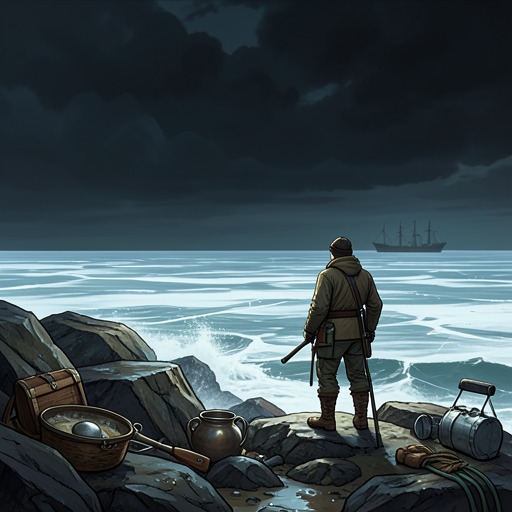
Augustine Refuses to Evacuate Barbeau Observatory
Good Morning, MidnightAugustine Refuses to Evacuate Barbeau Observatory at the moment its scientific community is being dismantled. An Air Force evacuation offers the researchers a way out of an unfolding catastrophe, but Augustine knowingly rejects it. His choice leaves him behind in a place he regards as both his work and his life, turning a professional posting into an irrevocable isolation.
The evacuation order
The decision comes as the other civilian researchers are being removed from the observatory. The Air Force unit gathers them in the director’s office before packing up the base, and its captain reads the researchers’ names and explains when and how they are to board the Herc waiting on the runway. The urgency is practical and unmistakable: people and equipment must be transported, and the operation is already under pressure.
The crisis beyond the Arctic remains undefined. The researchers know that something catastrophic is happening in the outside world, but no one gives them more than that. They follow the evacuation instructions, packing quickly rather than questioning their rescuers. Augustine alone refuses to treat departure as the only reasonable response. When his name is called, he says he will not go. At first, a military member laughs, and some of the scientists sigh; his decision is not initially taken as serious.
A refusal made knowingly
Augustine’s reasoning is rooted in his attachment to the observatory. He will not be herded onto an aircraft, he insists, because his work is there and his life is there. He believes he can manage without the others and means to leave only when he is ready. The refusal is not presented as a misunderstanding about the evacuation plan: the captain makes its consequence explicit. Anyone remaining at the base will be marooned, and there will be no return flight.
Augustine answers that he understands and still will not leave. The captain sees an old man whose resolve appears irrational, but recognizes that he means what he says. With too many people and too much equipment to move, and too little time to spare, the captain does not halt the evacuation to argue. He does, however, pull Augustine aside after the meeting and warns him again that the consequences are real. Augustine brushes away the hand resting on his arm and tells the captain to back off. The confrontation ends without changing either man’s position: the evacuation will continue, and Augustine will stay.
The observatory after departure
From the south-facing windows on the top floor, Augustine watches the researchers carry packs, suitcases, books, equipment, and keepsakes between tents and outbuildings. He sees heavily loaded snowmobiles make repeated trips to the hangar, then watches the scientists trickle down toward the runway until he is alone. The aircraft rises from the concealed hangar among the folds of the tundra. Augustine remains at the window as it disappears into the pale sky and its engine fades into the wind.
The departure makes the captain’s warning concrete. Augustine stays at the window for a long time, allowing the loneliness of his situation to settle in, then turns back to the control room and shifts his colleagues’ remaining work aside to make the space his own. The room’s rearrangement is a small practical response to a much larger change: a shared research base has become his isolated station. He cannot fully take in the finality of having no return trip. The text gives his refusal a private counterweight, too: Augustine has no one to return to elsewhere, and at the observatory he does not have to be reminded of that absence.
What staying brings
The evacuation does not leave Augustine entirely alone for long. A day or two later, he finds Iris curled on a bare mattress in an empty dormitory, apparently left behind in the confusion. He brings her to the control room, gives her dried fruit and nuts and instant oatmeal, and tries to work around the unexplained presence of a silent child. He assumes someone will come back for her, as the researchers might have been separated by a mistake in the hurried departure. No one returns. The evacuation has therefore left more than one person outside the departing group, though Augustine’s decision to remain and Iris’s apparent abandonment are distinct circumstances.
When Augustine radios the Alert military base, there is no answer. He scans other frequencies as well: amateur radio, emergency communication satellites, and military aviation channels all give him only silence and static. He tells himself it may be a glitch or a storm and plans to try again. In the observatory, staying means more than refusing the aircraft; it means confronting the possibility that there may be no one left within reach to answer.
From refusal to listening
Augustine’s later use of radio gives his isolation a recurring, concrete form. After fine-tuning his equipment, he transmits his call sign, KB1ZFI, and asks whether anyone is there. At Lake Hazen, he again scans through the winter quiet, where the receiver’s static offers a sound against the stillness. A faint voice eventually reaches him; uncertain that he has heard anything, he calls out and tries again until a woman answers clearly. These later moments do not undo the evacuation or make the captain’s warning less final. They show instead how Augustine’s choice to stay develops into a life organized around the possibility of contact: the man who watched the aircraft leave later uses the radio to test whether another human presence remains.